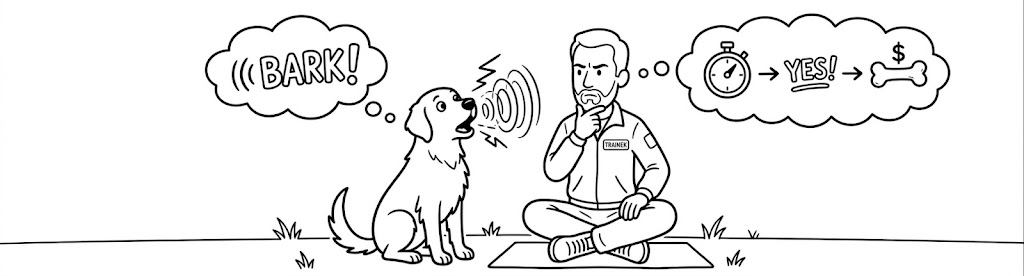
Stop dog barking with positive methods
Barking is normal dog communication, but when it becomes constant, your neighbors complain, or your dog seems stressed, you need a plan that addresses the why, not just the volume. Positive, LIMA-aligned methods teach quieter alternatives without suppressing your dog's voice through fear.
Understand what barking is doing for your dog
Behavior has a function. Alert barking warns the household; frustration barking says "I want that dog to go away"; attention barking works if you eventually shout or toss a treat to buy silence. Write down when barking starts, what happened just before, and what your dog gained. A training journal makes these patterns visible across days instead of relying on memory after a frustrating evening.
Medical causes matter too. Pain, hearing changes, or cognitive decline can increase vocalization. Rule out health issues with your veterinarian before assuming the problem is purely behavioral.
Manage the environment first
Prevention is the least intrusive step in LIMA. Block visual triggers with frosted film, white noise, or curtains. Give your dog a quiet retreat during delivery hours. Avoid leaving them at windows unsupervised while the barking habit is still strong, every rehearsal strengthens the neural pathway.
Exercise and enrichment reduce boredom barking. Sniff walks, food puzzles, and short training games burn mental energy that might otherwise become noise.
Teach incompatible and alternative behaviors
You cannot train "don't bark" directly, there is nothing to mark. Instead, teach what you want: a mat settle, a touch cue, or a quiet "thank you" protocol where one alert bark earns praise and a check of the window, then you redirect to a chew on their bed.
Use positive reinforcement generously for quiet moments. Capture silence, mark and treat when your dog notices a trigger but chooses not to bark. That proactive reinforcement builds the habit of calm observation.
Desensitize and counter-condition
For fear-based barking, work below threshold. Present triggers at a distance where your dog notices but can still take treats. Pair the trigger with high-value food. Over sessions, decrease distance as your dog's body language stays loose. Rushing this process floods your dog and can worsen barking, the opposite of LIMA.
What to avoid
Shouting, shock collars, and citronella sprays may stop barking briefly but often increase stress and damage trust. They tell your dog that the world, or you, is unsafe. Humane training invests in teaching and management because the results compound over years, not just minutes.
More context on ethical frameworks lives in our Guides hub and in the article on LIMA dog training.
Frequently asked questions
- Why does my dog bark so much?
- Dogs bark to communicate alarm, frustration, excitement, or attention-seeking. Identifying the function, what your dog gets from barking, is the first step toward changing the behavior with positive methods.
- Will ignoring barking make it stop?
- Extinction can work for attention barking if you consistently withhold the reward and reinforce quiet instead. For fear or alert barking, ignoring alone usually fails, you need management, desensitization, and taught alternatives.
- Are bark collars humane?
- Operant follows LIMA principles and does not recommend aversive collars that punish barking through shock, spray, or ultrasonic discomfort. They suppress symptoms without addressing underlying needs and can increase anxiety.
Track barking triggers and progress in Operant, journal, coach, and share protocols with sitters.
Join the waitlist